
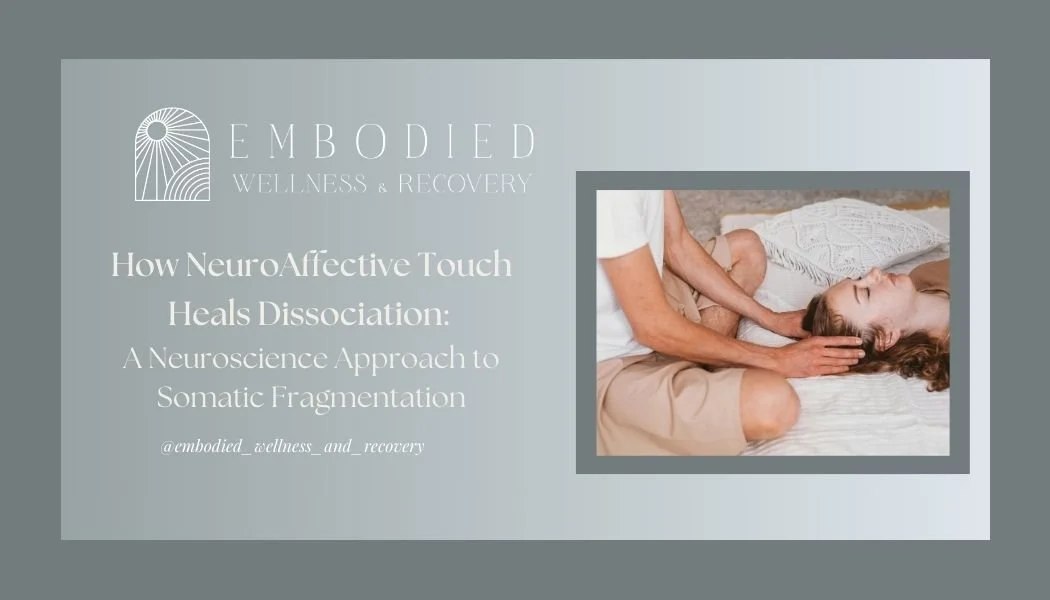
How NeuroAffective Touch Heals Dissociation: A Neuroscience Approach to Somatic Fragmentation
How NeuroAffective Touch Heals Dissociation: A Neuroscience Approach to Somatic Fragmentation
Discover how NeuroAffective Touch supports healing from dissociation, somatic fragmentation, and unresolved trauma by integrating body-based safety, nervous system repair, and relational regulation.
How NeuroAffective Touch Heals Dissociation: A Neuroscience Approach to Somatic Fragmentation
Dissociation can feel confusing, frightening, and profoundly isolating. Many people describe it as “being here but not here,” “watching life from the outside,” or “feeling disconnected from my body.” For others, it shows up as numbness, zoning out, emotional deadness, or losing time. These experiences are not a sign of weakness. They are the nervous system’s attempt to survive overwhelming experiences that the body could not process at the time.
But dissociation does not only affect thoughts. It affects the body. It fragments physical sensations, emotional presence, and a core sense of self. Trauma disrupts the relationship between mind, body, and identity, leaving people feeling scattered, unsafe, or disconnected inside their own skin.
This is where NeuroAffective Touch becomes uniquely powerful. Unlike talk therapy alone, which often cannot reach the implicit memory systems where trauma is stored, NeuroAffective Touch works directly with the nervous system to restore safety, integration, and embodied presence.
At Embodied Wellness and Recovery, NeuroAffective Touch is integrated into our trauma-informed approach to help clients restore connection, wholeness, and self-regulation from the inside out.
What Is NeuroAffective Touch?
NeuroAffective Touch is a somatic, relational, hands-on therapeutic modality developed by Dr. Aline LaPierre. It is grounded in developmental neuroscience, attachment theory, and polyvagal principles. The method uses skilled, respectful, attuned touch to regulate the nervous system and repair early attachment injuries.
Unlike massage or bodywork, NeuroAffective Touch focuses on emotional and relational development. The touch is slow, intentional, and supportive. It offers the body an experience of co-regulation and safety that may have been missing during crucial early periods of life.
NeuroAffective Touch communicates safety where words alone cannot.
Why Trauma Creates Dissociation and Fragmentation
Trauma overwhelms the brain’s capacity to regulate emotional and physiological states. When the nervous system cannot escape, fight, or seek safety, it may default to dissociation.
Dissociation serves as a biological protective mechanism by:
— Numbing overwhelming sensations
— Disconnecting from emotional pain
— Distancing from the environment
— Reducing awareness to tolerate threat
Although dissociation can protect a person in the moment, chronic dissociation impairs daily functioning. It disrupts:
— Emotional regulation
— Stable sense of self
— Physical presence
— Connection with others
— Ability to feel safe
— Capacity for intimacy
Many people with early trauma describe feeling “cut off” from their bodies or “floating through life.”
NeuroAffective Touch offers a pathway back.
The Neuroscience Behind Somatic Fragmentation
Somatic fragmentation occurs when the nervous system organizes itself around survival rather than connection. Trauma disrupts integration in several key areas:
1. The Polyvagal System
Trauma often forces the body into dorsal vagal shutdown, leading to numbness, collapse, and disconnection.
2. The Amygdala and Limbic System
Overactivation keeps the body on alert, leading to hypervigilance and emotional overwhelm.
3. The Prefrontal Cortex
Trauma reduces access to executive functioning, making grounding and presence difficult.
4. Implicit Memory Networks
Trauma is stored nonverbally in the body, not in words. These memories must be processed through sensation, movement, and relational attunement.
5. Attachment Pathways
Early relational trauma creates disrupted internal maps that shape emotional regulation, touch tolerance, and relational safety.
NeuroAffective Touch specifically targets these systems through the language of the body.
How NeuroAffective Touch Helps Heal Dissociation
NeuroAffective Touch supports dissociation recovery by working directly with the nervous system and the body’s relational wiring.
1. It Restores Safety Through Co-Regulation
Trauma often occurs without the presence of a supportive adult. Attuned touch gives the body an experience it may never have received: a safe, nurturing, regulated presence.
2. It Reconnects the Body and Mind
Touch helps reintegrate sensory, emotional, and physical awareness. Clients begin noticing sensations they previously had no access to.
3. It Heals Developmental Attachment Injuries
Gentle touch communicates attunement, presence, and care, which support the repair of early relational wounds.
4. It Supports Emotional Regulation
Slow, intentional touch stimulates the ventral vagal system, promoting calmness and resilience.
5. It Rewrites Implicit Memory
Trauma stored in the body is accessed and reorganized through therapeutic touch and relational presence.
6. It Reduces Shame and Self-Blame
The experience of being cared for at a nervous system level counters deep shame narratives that trauma often leaves behind.
7. It Supports Integration and Wholeness
Clients often describe feeling “more in their body,” “more real,” or “able to feel again.”
What a Session Looks Like
NeuroAffective Touch sessions are gentle, slow, and deeply collaborative. Clients remain fully clothed. Touch may be applied to areas associated with developmental attachment, such as the upper back, arms, hands, pelvis, or feet.
Sessions may include:
— Grounding and sensory tracking
— Guided breath awareness
— Hands-on support to specific regions of the body
— Relational attunement and co-regulation
— Verbal reflection to integrate physical experiences
The goal is always safety, choice, and honoring the client’s pace.
Who Can Benefit from NeuroAffective Touch?
Individuals experiencing:
— Dissociation
— Somatic numbness
— Emotional shutdown
— Chronic freeze
— Complex PTSD
— Developmental trauma
— Attachment wounds
— Difficulty with embodied presence
— Fragmentation or inner disconnection
— Difficulty tolerating emotional closeness
Often find NeuroAffective Touch deeply transformative.
How NeuroAffective Touch Fits into Trauma Treatment at Embodied Wellness and Recovery
At Embodied Wellness and Recovery, NeuroAffective Touch is integrated with:
— EMDR therapy
— Attachment-focused EMDR
— Somatic Experiencing
— IFS and parts work
— Polyvagal-informed therapy
— Mindfulness and breath-based regulation
— Trauma-informed relational psychotherapy
This integrative approach helps clients rebuild safety, connection, and emotional resilience at both a cognitive and cellular level.
Trauma may fracture the body’s sense of wholeness, but the nervous system is capable of profound repair when given the right conditions.
A Pathway Back to Yourself
Dissociation and somatic fragmentation are not signs of weakness. They are evidence of the body’s incredible ability to survive. NeuroAffective Touch offers a compassionate, neuroscience-informed pathway to reconnect with your body, restore emotional presence, and rebuild inner coherence.
With attuned support, the body can learn to feel safe again. The mind can return home to the body. And the fragmented parts can integrate into a grounded, connected whole.
Reach out to schedule a complimentary 20-minute consultation with our team of therapists, trauma specialists, somatic practitioners, or relationship experts, and start working towards integrative, embodied healing today.
📞 Call us at (310) 651-8458
📱 Text us at (310) 210-7934
📩 Email us at admin@embodiedwellnessandrecovery.com
🔗 Visit us at www.embodiedwellnessandrecovery.com
👉 Check us out on Instagram @embodied_wellness_and_recovery
🌍 Explore our offerings at Linktr.ee: https://linktr.ee/laurendummit
References
1) LaPierre, A. (2021). NeuroAffective Touch: Healing through the body in psychotherapy. W. W. Norton.
2) Porges, S. W. (2017). The pocket guide to the polyvagal theory: The transformative power of feeling safe. W. W. Norton.
3) Siegel, D. J. (2020). The developing mind: How relationships and the brain interact to shape who we become (3rd ed.). Guilford Press.

The Power of Self-Forgiveness: Why It’s So Hard and How to Release Shame for Good
The Power of Self-Forgiveness: Why It’s So Hard and How to Release Shame for Good
Struggling with self-forgiveness and stuck in the shame spiral? Discover why it’s so difficult and explore expert-backed steps to release shame, rebuild self-worth and restore emotional resilience.
Can You Relate?
Have you ever wondered why you can forgive others so easily, yet find it in yourself to forgive your own mistakes feels nearly impossible? Why do you keep looping in that internal voice of criticism, replaying the past, and sinking deeper into shame? Self-forgiveness is one of the most elusive yet powerful acts of healing, especially when trauma, nervous-system dysregulation, or relational wounding are involved. At Embodied Wellness and Recovery, we specialize in working with these underlying dynamics, helping clients move beyond self‐condemnation and toward embodied worth, emotional freedom, and genuine connection.
Why Self-Forgiveness Feels So Difficult
The Shame Spiral and Its Toll
You may ask:
— Why do I replay that moment I hurt someone over and over when I’ve apologised already?
— Why can’t I stop feeling like I’m defined by one bad choice or one failure?
— Why does feeling “less than” have more power than feeling hopeful in me?
These aren’t simple questions; they point to how shame and self-judgment work in our brains and bodies. Shame is not just guilt (“I made a mistake”) but a painful feeling about who we are (“I am bad”). And neuroscience shows that shame activates brain regions like the anterior cingulate cortex, parahippocampal gyrus, and medial frontal gyrus, areas tied to self-evaluation, moral emotions, and social threat.
The Brain Behind the Burden
Self-forgiveness research points to another layer: people who are better at forgiving themselves show stronger self-compassion, greater resilience, and even measurable brain differences. For example, a recent MRI study found that individuals with high self-forgiveness had greater gray matter volumes in regions associated with self-compassion and moral processing. This means that self-forgiveness is not just a “soft” concept; it is linked to tangible brain and nervous system shifts.
When shame dominates, the nervous system can stay locked in threat mode: high heart rate, tight muscles, foggy attention, and craving avoidance or escape. That physiological stress makes it nearly impossible to access safety, let alone compassion for ourselves.
The Key Obstacles to Self-Forgiveness
1) Unrelenting self-judgment
If your inner critic is louder than your inner ally, you’ll likely stay trapped in shame. The more you judge yourself, the more you activate threat networks in your brain.
2) Fear that forgiving yourself means you “let yourself off the hook”
Many people resist self-forgiveness because they believe accountability means punishment. In fact, unresolved self-shame often leads to self-sabotage.
3) Lack of nervous system regulation
Trauma, chronic stress, or emotional neglect diminishes our capacity to regulate. Without regulation, self-compassion and forgiveness feel unsafe or impossible.
4) Misunderstanding the process
Self-forgiveness is rarely a one-time event; it is a layered, ongoing stance of compassion, responsibility, and integration. Research shows it is best understood as a “mixed emotional experience” rather than a single moment of letting go.
Expert Advice for Releasing Shame and Cultivating Self-Forgiveness
Step 1: Ground your body
Begin by calming your nervous system. Before you even approach the memory or the thought:
— Take slow belly breaths, activating your vagus nerve and shifting the system toward safety.
— Scan your body and notice where tension, tightness, or contraction is held. Allow softening, shifting from fight or freeze mode into rest-and-digest.
Once the body is better regulated, the brain can engage in reflection without the immediate threat.
Step 2: Name and Witness Your Story
Ask yourself: What triggered the shame? What did I need at that moment that I did not receive or give myself? Use present-tense statements such as:
“I did X. I felt Y. I needed Z.”
The act of naming gives you agency and moves shame from implicit somatic memory into conscious narrative.
Step 3: Shift the Relationship to the Self
Replace condemnation with compassion. Self-compassion research (Neff, 2022) shows that treating ourselves with kindness allows for emotional regulation, neural flexibility, and healing.
Use mindful statements:
“I recognise that I acted from the best I knew at that time.”
“I choose to care for this part of me that carries the pain.”
These re-frames don’t undo the past, but they re-shape your nervous system’s story about the past—moving from threat to possibility.
Step 4: Repair and Re-engage with Your Values
Self-forgiveness also involves alignment with deeper values: integrity, kindness, and connection. Ask: “What can I do now (even in a small way) that affirms who I truly am, not who I fear I was?”
Making symbolic or practical reparative actions without waiting for perfection, but taking conscious steps toward values, gives your nervous system real data: you can choose differently now.
Step 5: When Trauma’s Tootprint Runs Deep
If you find yourself stuck: repeating shame loops, dissociation, overwhelming guilt, or you are unsure how to move forward, then a trauma-informed, somatic approach is essential. At Embodied Wellness and Recovery, we integrate somatic experiencing, nervous system regulation, EMDR, parts work, and relational therapy to help you reclaim your embodied life, restore boundaries, and nurture inner safety.
The Hope of Self-Forgiveness: Reclaiming Your Life
Imagine this: you're no longer defined by the mistake you made or the moment you regret. Your nervous system no longer lights up at the memory. Instead, you respond with: “I took responsibility, I learned, I am worthy of connection and rest.” That shift transforms not only how you feel about yourself, but how you show up relationally, how you live in your body, how you move through the world.
Self-forgiveness is not indulgence; it is an act of integration. When you forgive yourself, you free energy previously locked in shame. You reclaim your capacity for intimacy, pleasure, creativity, and connection. The burden of self-condemnation lifts, and you begin to live with internal freedom.
Why Embodied Wellness & Recovery Brings a Unique Approach
At Embodied Wellness and Recovery, we do more than talk about self-forgiveness. We practise it somatically, relationally, and neuro-scientifically. We help you:
— Feel safety in your nervous system.
— Rewrite the body’s memory of shame.
— Reconnect with parts of you you thought were lost.
— Build relational trust with yourself, your body, and others.
When shame dissolves and forgiveness takes root, your life becomes a place of curiosity and renewal rather than fear and concealment.
Reclaim a Life That Reflects Safety, Integrity, and Connection
Struggling with self-forgiveness is not a sign that you're “weak.” It often means your body, mind, and nervous system have carried too much for too long. The shame spiral is real, painful, but also a doorway to profound change. Through grounding, naming the story, softening self-criticism, aligning with values, and (when needed) trauma-informed support, you can shift your neural pathways, regulate your nervous system, and reclaim a life that reflects safety, integrity, and connection.
If you’re ready to explore this journey toward embodied self-compassion, clearer relationships, and nervous-system regulation in depth, discover how Embodied Wellness and Recovery can support you in reclaiming your wholeness.
Reach out to schedule a free 20-minute consultation with our team of therapists, trauma specialists, somatic practitioners, relationship experts and begin practicing self-compassion today.
📞 Call us at (310) 651-8458
📱 Text us at (310) 210-7934
📩 Email us at admin@embodiedwellnessandrecovery.com
🔗 Visit us at www.embodiedwellnessandrecovery.com
👉 Check us out on Instagram @embodied_wellness_and_recovery
🌍 Explore our offerings at Linktr.ee: https://linktr.ee/laurendummit
References
Kim, H.-J., & colleagues. (2023). Self-forgiveness is associated with increased volumes of … Scientific Reports. https://doi.org/10.1038/s41598-023-32731-0 Nature
Michl, P., et al. (2012). Neurobiological underpinnings of shame and guilt: A pilot functional magnetic resonance imaging study. Frontiers in Psychology. PMC
Woodyatt, L., & colleagues. (2025). What makes self-forgiveness so difficult? Self and Identity. Taylor & Francis Onlin

Why Asking ‘Why Me?’ Can Be the First Step to Healing Trauma and Reclaiming Meaning
Why Asking ‘Why Me?’ Can Be the First Step to Healing Trauma and Reclaiming Meaning
Wondering "Why me?" after trauma? Learn how this question can become a catalyst for healing, meaning-making, and deep nervous system repair.
Why Asking “Why Me?” Can Be the First Step to Healing Trauma and Reclaiming Meaning
Trauma has a way of shattering the stories we tell ourselves about the world, about safety, fairness, identity, and control. And in the aftermath, one of the most common and agonizing questions that arises is: “Why me?”
Maybe you’ve asked this in a quiet moment, tears streaming down your face. Perhaps you’ve screamed it into the void. Or maybe it’s lingered silently, under the surface of your day-to-day functioning, driving your anxiety, depression, or shame.
At Embodied Wellness and Recovery, we’ve heard this question from countless clients, survivors of abuse, betrayal, chronic illness, accidents, abandonment, and more. And while the question may feel like a roadblock, it can actually be a profound doorway: a starting point for meaning-making, nervous system repair, and more profound healing than you ever thought possible.
Why “Why Me?” Hurts So Much
The question “Why me?” often arises from a place of shock, grief, or injustice. It's a cry from the part of us that still believes in a moral universe, where if we do good, we should receive good. So when trauma strikes, it’s not just painful; it feels disorienting, even existential.
This question becomes especially heavy when paired with:
— Survivor’s guilt
— Self-blame or shame
— A history of repeated trauma
— Unprocessed childhood attachment wounds
It’s natural to seek meaning after trauma. In fact, meaning-making is one of the key predictors of post-traumatic growth, a concept in trauma research that describes the possibility of becoming more resilient, self-aware, and connected after surviving adversity (Tedeschi & Calhoun, 2004).
But Neuroscience Tells Us This: Trauma Disconnects Before It Can Integrate
When a traumatic event occurs, the amygdala (the brain’s threat detection system) hijacks the nervous system. The prefrontal cortex, responsible for logic, language, and meaning, goes offline. This is why you might find yourself stuck in repetitive thoughts, emotional flooding, or dissociation.
Asking “Why me?” can feel like searching for answers in the fog. But that doesn’t mean the question is wrong; it means your nervous system needs support to process it. This is where somatic and trauma-informed approaches like EMDR (Eye Movement Desensitization and Reprocessing), Somatic Experiencing, and parts work come in. At Embodied Wellness and Recovery, we help clients slow down, regulate, and return to the question from a place of curiosity rather than collapse.
When “Why Me?” Becomes a Catalyst for Healing
The transformation happens not by dismissing the question, but by expanding it:
— What meaning am I attaching to this event?
— What old wounds or beliefs has this trauma reactivated?
— What needs to be grieved, acknowledged, or reclaimed?
— How might I grow from this, not despite it, but because of how I tend to it?
This is the work of narrative integration, the process of transforming trauma into a story, chaos into coherence, and pain into purpose. According to Dr. Dan Siegel’s research on mindsight and narrative repair, this kind of integration strengthens brain functioning, self-awareness, and emotional regulation (Siegel, 2010).
Reclaiming Agency Through Meaning-Making
Here’s the shift: “Why me?” is no longer a question asked from powerlessness, but from self-inquiry.
Consider how trauma-informed therapy can help reframe and rewire:
Old Thought New Perspective Through Healing
Why did this happen to me? What is this pain inviting me to learn or unlearn?
I must have done something wrong. No one deserves to be hurt; this wasn’t my fault.
I’ll never be the same. I’ve changed, but I get to decide what that means.
In EMDR, for example, clients reprocess not only memories but also the core beliefs that accompany them. These might include “I’m unsafe,” “I’m broken,” or “I’m unlovable.” Through bilateral stimulation and targeted memory work, these beliefs are replaced with adaptive truths, like “I survived,” “I’m resilient,” and “I can trust myself again.”
From Suffering to Sacred Inquiry
In many spiritual and philosophical traditions, the question “Why me?” is not viewed as futile but as sacred. It’s the human impulse to understand, to connect, to assign value to our pain. In this way, the question itself is an act of resilience.
At Embodied Wellness and Recovery, we invite clients to explore not only the psychological but also the spiritual dimensions of trauma recovery. This includes:
— Rebuilding a sense of trust in self, others, or the universe
— Exploring existential beliefs that were fractured by trauma
— Engaging in practices of self-compassion, embodiment, and ritual
These elements can be deeply grounding for survivors who feel emotionally fragmented or disconnected from a larger sense of purpose.
How We Help Clients Turn “Why Me?” Into “What Now?”
Our trauma-informed, somatic, and neuroscience-based approach includes:
1. EMDR Therapy
To reprocess the stuck memories and beliefs that keep the nervous system in survival mode.
2. Somatic Therapy
To bring the body into the healing process through grounding, movement, and interoception, helping clients feel safe and present again.
3. Parts Work/Internal Family Systems (IFS)
To build inner relationships with the wounded parts that carry the shame, fear, and grief associated with trauma.
4. Narrative and Meaning-Making Therapy
To support the integration of trauma into a coherent, empowered personal story.
What If the Question Isn’t the Problem?
What if “Why me?” is not something to silence or escape but something to stay with, gently, until the nervous system is ready to metabolize the pain?
At Embodied Wellness and Recovery, we don’t rush this process. We walk with you through it. Our team specializes in trauma, mental health, relationships, sexuality, and intimacy because we know trauma touches every layer of who we are. You don’t have to erase the question. You get to rewrite the story in which it resides. Reach out to schedule a free 20-minute consultation with our team of top-rated therapists and take the next step toward a regulated nervous system today.
📞 Call us at (310) 651-8458
📱 Text us at (310) 210-7934
📩 Email us at admin@embodiedwellnessandrecovery.com
🔗 Visit us at www.embodiedwellnessandrecovery.com
👉 Check us out on Instagram @embodied_wellness_and_recovery
🌍 Explore our offerings at Linktr.ee: https://linktr.ee/laurendummit
References
Siegel, D. J. (2010). The Mindful Therapist: A Clinician's Guide to Mindsight and Neural Integration. W. W. Norton & Company.
Tedeschi, R. G., & Calhoun, L. G. (2004). Posttraumatic Growth: Conceptual Foundations and Empirical Evidence. Psychological Inquiry, 15(1), 1–18. https://doi.org/10.1207/s15327965pli1501_01
Van der Kolk, B. (2014). The Body Keeps the Score: Brain, Mind, and Body in the Healing of Trauma. Viking.